

Medically Reviewed & Authored by:
Dr. Md. Abdullah Yousuf (Doctor of Osteopathic Medicine, USA) &
Dr. Tazia Sardar (Doctorate in Physical Therapy, USA).
Specialists in Non-Surgical Spine Rehabilitation & Osteopathic Manual Therapy at Back in Motion.
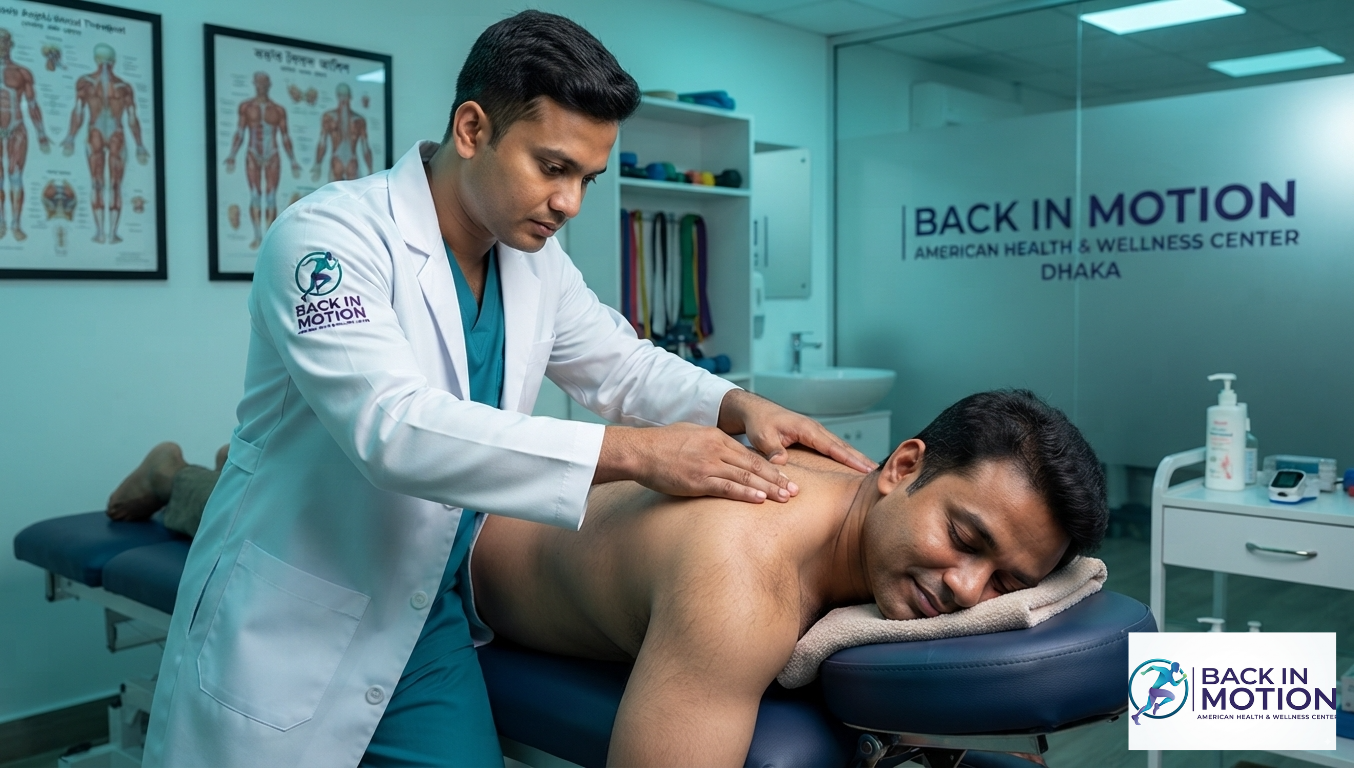
Persistent tightness at the base of your skull, painful muscle knots across your upper back, and limited head rotation are primary warning signs of myofascial pain syndrome. When posture strain, high stress, or sudden movements overwork the neck musculature, hyperirritable spots—commonly known as trigger points—develop within the levator scapulae, upper trapezius, and suboccipital muscles. Achieving sustainable back neck pain relief requires moving beyond temporary heat packs to address these localized tissue restrictions through targeted hands-on interventions.
At Back in Motion, our clinical specialists utilize advanced osteopathic manual techniques, targeted pressure application, and dry needling to deactivate pain-generating knots, decompress nerve pathways, and restore normal cervical movement mechanics.
Understanding Trigger Points & Acupressure Points for Neck Pain
A myofascial trigger point is a hyperirritable nodule located within a taut band of skeletal muscle. When squeezed or stressed, these knots produce both local tenderness and referred pain patterns that travel into the shoulders, mid-back, or front of the forehead.
While many individuals explore non-invasive pressure mapping or self-massage on specific acupressure points for neck pain—such as the GB20 (Feng Chi) at the base of the skull or LI4 (Hegu) on the hand—clinical manual therapy takes this concept further. Physical specialists combine anatomical precision with biomechanical evaluation to treat both active muscular knots and underlying joint restrictions.
- Suboccipital Muscle Knots: Located directly beneath the skull base; frequently trigger dull, band-like tension headaches (cervicogenic headaches).
- Levator Scapulae Trigger Points: Situated along the side of the neck down to the inner shoulder blade; responsible for acute “stiff neck” locking.
- Upper Trapezius Hypertonicity: Caused by forward-head posture and rounding shoulders, creating deep aching across the upper back.
Actionable Clinical Modalities for Neck and Shoulder Pain Relief
Achieving fast, lasting neck and shoulder pain relief requires a multi-faceted rehabilitation plan tailored to the depth of muscle tightness and joint compression. Following global World Physiotherapy standards, our clinicians combine the following evidence-based techniques:
1. Clinical Myofascial Release (MFR) & Ischemic Compression
Direct, sustained manual pressure applied to active trigger points starves the muscle spasm of excess nerve signals, forcing the tight fibers to lengthen and release. This restores blood flow and oxygenation to previously oxygen-deprived tissue.
2. Trigger Point Dry Needling
Using ultra-thin, sterile solid filament needles inserted directly into hyperirritable knots, dry needling triggers a brief involuntary spinal reflex called a “local twitch response.” This twitch immediately resets muscle tone, releases chemical inflammatory mediators, and provides rapid pain relief.
3. Cervical & Thoracic Joint Mobilization
Muscles often lock up to protect stiff, hypomobile spinal joints. By applying gentle, skilled passive movements to restricted cervical and upper back joints, manual therapy unlocks joint mechanics so relaxed muscles remain loose longer. If your discomfort extends beyond local stiffness into numbness or tingling down your arm, review our complete guide on radiating symptoms and nerve root irritation.
4. Postural Retraining & Sleep Ergonomics
Manual therapy creates a window of pain-free mobility. Sustaining these gains requires correcting daytime screen posture and addressing nighttime habits. If you frequently wake up with acute morning spasms, explore our clinical guide on fixing neck pain from sleeping wrong.
3 Actionable Exercises to Relieve Muscle Knots at Home
Incorporate these targeted exercises into your daily routine to maintain tissue length between clinical therapy sessions:
- Chin Tucks (Deep Neck Flexor Activation): Sit upright. Look straight ahead and gently glide your head backward as if making a double chin. Hold for 5 seconds; repeat 10 times to decompress the upper cervical spine.
- Upper Trapezius Stretch: Sit on your right hand to anchor your shoulder. Gently tilt your left ear toward your left shoulder using your opposite hand for light guidance. Hold for 20–30 seconds per side.
- Levator Scapulae Active Release: Turn your head 45 degrees to the left, then look down toward your left armpit. Place your left hand gently on the back of your head to enhance the stretch along the right side of your neck. Hold for 30 seconds.
For comprehensive diagnostic evaluations and long-term recovery plans, consult our main clinical overview on physiotherapy for cervical neck pain.
Need Clinical Assessment for Persistent Neck Pain?
Visit Back in Motion in Gulshan (Dhaka) or our Khulna Branch on the Khulna-Satkhira Highway for international-standard manual therapy and individualized spine care.
📞 Dhaka Helpline: +880 1313-717272 |
📞 Khulna Helpline: +880 1313-717271
Frequently Asked Questions
1. How does manual therapy provide fast back neck pain relief?
Manual therapy directly deactivates muscle spasms, reduces local tissue tension, and improves joint mobility through skilled hands-on manipulation, providing immediate relief compared to passive electrical modalities.
2. Are acupressure points for neck pain effective for long-term recovery?
Self-applied pressure on acupressure points provides temporary symptomatic relaxation, but long-term recovery requires clinical assessment to resolve underlying biomechanical joint dysfunctions and muscle imbalances.
3. What is the difference between myofascial release and traditional deep tissue massage?
Myofascial release focuses specifically on the fascia (connective tissue envelope) and neurological trigger points using sustained, targeted pressure and precise anatomical positioning, rather than general sweeping stroke massage.
4. Does dry needling hurt when treating neck and shoulder pain?
Most patients feel only a brief, minor deep ache or localized twitch response when the needle strikes an active trigger point. This response indicates that the muscle knot is deactivating.
5. Can trigger point therapy help with cervicogenic headaches?
Yes. Releasing active trigger points in the suboccipital and upper trapezius muscles directly eliminates referred pain patterns that travel up into the skull and eyes.
6. How many manual therapy sessions are needed for neck and shoulder pain relief?
Most patients notice significant reductions in tightness and improved mobility within 3 to 5 sessions, followed by a personalized corrective exercise plan.
7. Is manual trigger point release safe for acute neck spasms?
Yes, when performed by licensed physical specialists. Therapy is carefully modulated to avoid defensive guarding, gently releasing spasms without causing tissue trauma.
8. Can poor sleep ergonomics reactivate muscle trigger points?
Unsupportive pillows or awkward sleeping angles keep neck muscles in a shortened, strained state overnight, which can reactivate previously treated trigger points.
9. How do I know if my neck pain is muscular or nerve-related?
Muscular pain usually presents as localized aching or tightness that worsens with specific movements. Nerve irritation typically causes sharp, shooting pain, numbness, or tingling traveling down into the arm and fingers.
10. Where can I get professional manual therapy in Bangladesh?
You can receive evidence-based manual therapy at Back in Motion’s state-of-the-art clinics located in Gulshan-1 (Dhaka) and on the Khulna-Satkhira Highway (Khulna).